Fynd: Warehouse Management System · Visit WMS →
An MVP warehouse management system for Fynd, built as sole design DRI across a web app for managers and a handheld app for floor workers.
Fynd was building a supply chain suite for Reliance Jio, a key client. A Warehouse Management System, paired with a Transportation Management System, would give full visibility and control from purchase order through to delivery.
Key takeaway
Sole design DRI on a 0 to 1 warehouse management system, covering a manager web app and a worker handheld app. Shipped with 100% inventory traceability at item level and 100% picking accuracy, with 99.9% of orders processed within SLA.
100%
Inventory traceability
at item level
100%
Picking accuracy
after rollout
99.9%
Of orders processed
within SLA
10%
Improvement in
manpower efficiency
Context
Build an MVP that lets a mid-sized warehouse run end to end, for a client whose sites vary in layout, process, and staffing.
The brief was to cover the basics well: a web app for warehouse managers to monitor operations, a Pick Pack app for floor workers using RFID so data updates without manual entry, and a workflow builder able to cover different warehouse processes.
The hard part was not the feature list. Warehouses vary widely in layout and process, with no single standard to design for, so anything designed around one site would break at the next.
The project also started without the usual scaffolding, which shaped how the work had to be run.
My role
I owned the full design process: translating business requirements into user flows, running the research, and syncing weekly with the Design Manager and dev team on technical constraints.
With no other designer on the project, decisions that would normally be debated in a design team had to be made and defended alone, then validated against engineering feasibility each week.
Research
None of us had designed for warehouse operations before, so the first move was to go and watch one work.
We visited one of India’s largest warehouses to see firsthand how packages move from intake to delivery. Seeing the floor is what surfaced the constraints that mattered most: workers moving constantly between locations, gloved hands, scanners rather than keyboards, and steps that could not pause for a screen to load.
Alongside that, we benchmarked the WMS platforms already in use by Jio’s other vendors, to understand what the client’s teams were already fluent in.
Ravina
Supervisor
Goals
Ajay
Admin
Goals
Shyam
Worker
Goals
Approach
Each constraint had a design response. Naming those responses early is what kept a 0 to 1 build from becoming a pile of one-off screens.
Constraint 01
Constraint 02
Constraint 03
Constraint 04
The decision that mattered
PLACEHOLDER: this section carries the most weight with hiring managers. Replace the draft below with the decision you would actually defend in an interview.
The obvious path was to design the flow we had watched on our site visit and ship that. It would have been faster and it would have worked, for exactly one warehouse.
Instead I treated process variation as the core requirement rather than an edge case. The workflow builder meant a new site could be configured rather than redesigned, which is what let a single MVP serve warehouses that organise their floors differently.
PLACEHOLDER: add the trade-off. What did configurability cost, in build time, in interface complexity, or in what you had to leave out of the MVP?
Asset slot: workflow builder
A screenshot of the workflow builder or a configuration flow. This is the image that proves the decision above, so it does more work here than any other screen.
The interface
Low fidelity wireframes drove the structural decisions: cards to segment dense content, and clear headlines and breadcrumbs so people could tell where they were in a deep hierarchy.
The final UI ran on a minimal set of page templates rather than one-off layouts, with content surfaced through white cards on a light background.
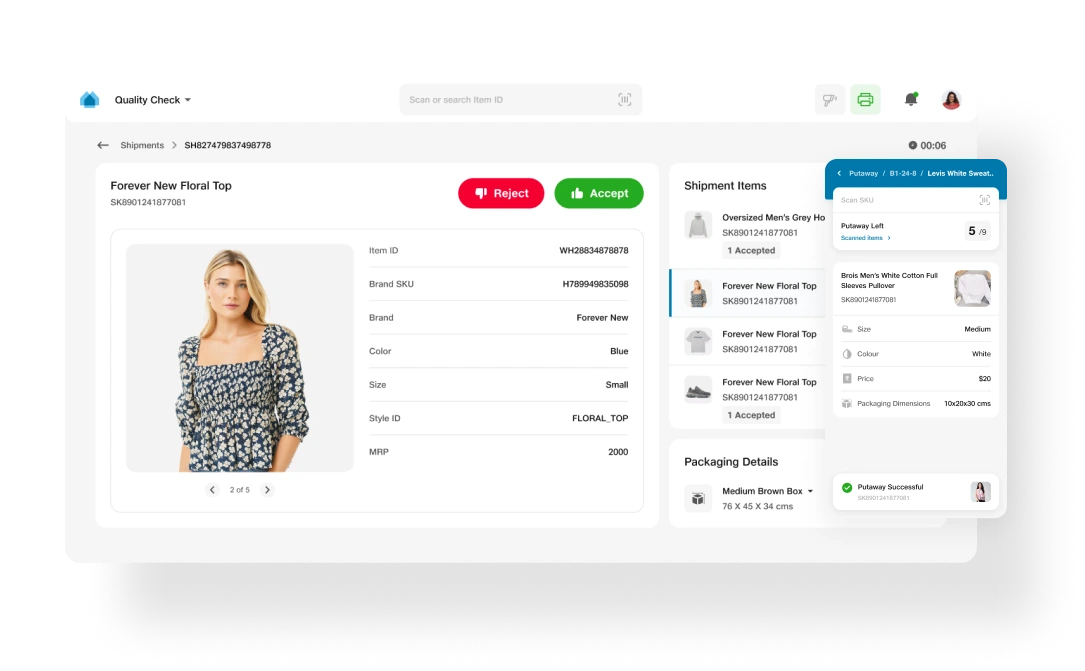
Inbound listing and detail. Consignments show status at a glance and stay tracked at item level until stock enters inventory. The form’s left nav stays fixed on scroll, so workers can jump to any section instantly.
Task screens for floor workers. Workers scan an item code at each step, which tracks its status through the system without manual entry.
Task completion. Once all items are scanned, a barcode generates automatically through the OMS API and the worker marks the order packed. Each scan gives immediate feedback and auto-advances to the next item, so the interaction works by scanner or by touch without changing the flow.
Asset slot: key screens
Two to four screens: inbound listing, a handheld task screen, and the task completion state. Handheld and desktop side by side would show the context-of-use split described above.
Outcome
The system was tested and shipped, and the numbers that mattered were operational rather than cosmetic.
Inventory traceability
100%
at item level
Picking accuracy
100%
after rollout
Orders within SLA
99.9%
processed on time
Manpower efficiency
+10%
improvement
PLACEHOLDER: add one or two sentences on what these numbers meant in practice. For example, what item level traceability changed for a supervisor chasing a missing consignment, or what 10% manpower efficiency was worth to the client.
Live product: fynd.com/en-in/wms
What I learned
PLACEHOLDER: this section is currently missing from the case study and hiring managers look for it specifically. Two or three paragraphs is enough.
Prompts, in case they help. What would you do differently now? One site visit informed the whole design, so would you have validated with floor workers sooner or more often? Did designing for configurability turn out to be the right call, or did it add complexity that a simpler system would have avoided? What did being sole DRI teach you about making decisions without a design team to argue with?
The durable lesson
One sentence that generalises past this project, in the way the Loco case study ends on a design system being a shared decision making tool rather than a component library.